
The Dose Makes the Poison?
Useful, but Maybe Not the Whole Truth?

I’ve recently seen a lot of poor commentary on this dictum, so I thought I’d write a little again from my perspective.
“The dose makes the poison” is among the most quoted principles in toxicology, yet it is also one of the most misunderstood. My continued discomfort with the phrase is not that it is wrong, but that it is incomplete. I recognize the historical context in which Paracelsus advanced this dictum - while defending medical and chemical ideas that have long since been abandoned. I have written about this previously: a story that runs from mercuric formulations, to arsenicals as “magic bullets” to antibiotics, and the intercontinental exchange of smallpox and syphilis.1 I’d also continue to recommend a careful reading of Paracelsus’ Third Defense as an historical analysis by Deichmann.2 If only to share…
“…I have defended and cleared myself and have shown my prescriptions are administered to the laws of nature, that you speak without knowledge, and rave like ignorant and thoughtless madmen ! - Paracelsus
The Paracelsian dictum has endured because of its simplicity. It’s not what he actually said. It captures an important truth that without exposure, a substance cannot produce a biological effect. But in reducing toxicology to a single variable, it compresses several distinct scientific principles into a memorable slogan, but neither toxicity nor therapeutic benefit is determined by dose alone.
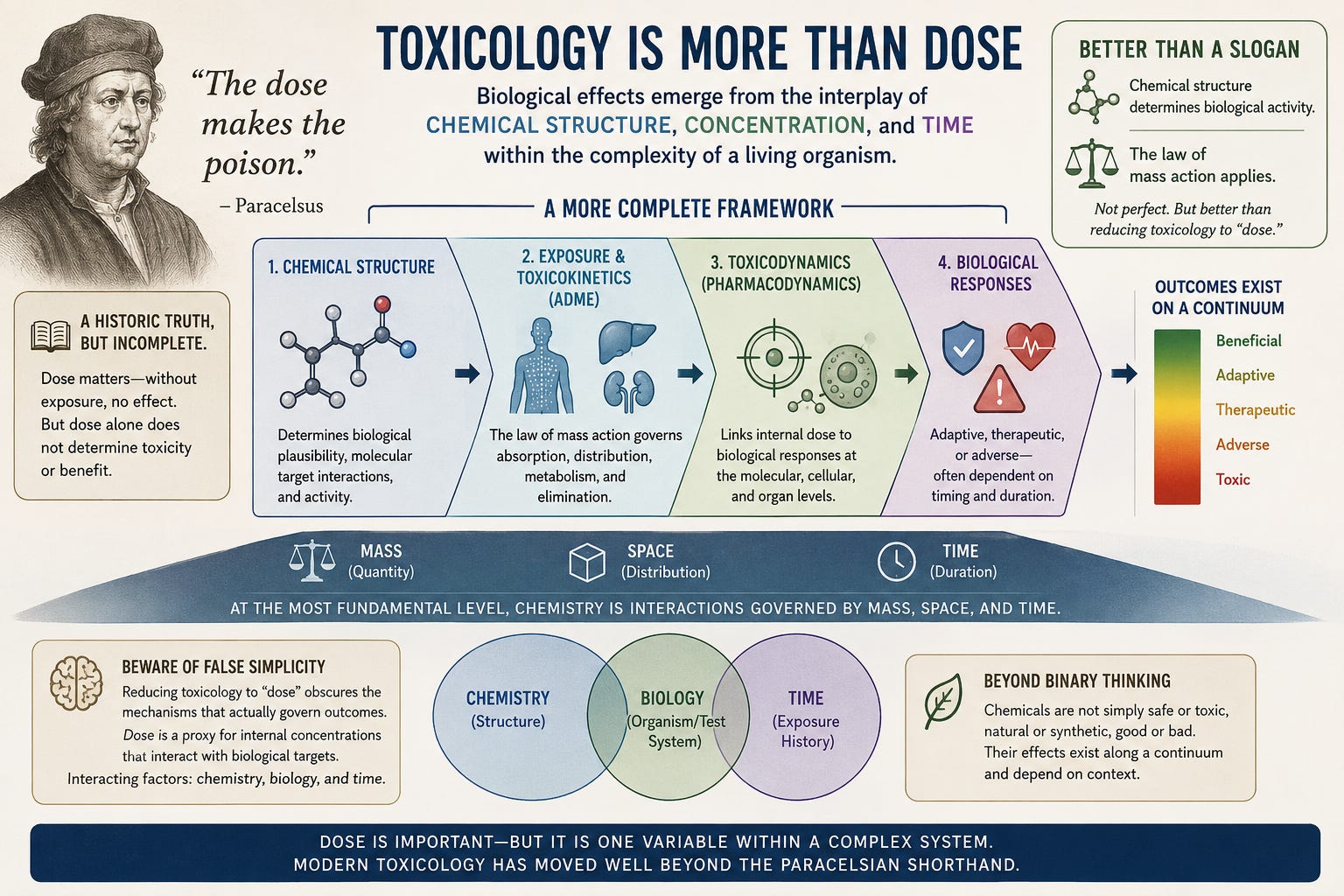
A more complete framework begins with first principles. Chemical structure determines biological plausibility, molecular target interactions, and activity. The law of mass action governs chemical and physical principles related to absorption, distribution, metabolism, and elimination (ADME). Pharmacodynamics (or, more broadly, toxicodynamics) then links exposure to biological responses, whether adaptive, therapeutic, or adverse where temporal relationships are perhaps equally important.
These are the fundamental determinants of biological effect: chemical structure, concentration (mass/volume), and time operating within the complex living organisms, or any test system. At an even more fundamental level, chemistry itself can be viewed as interactions governed by mass, space, and time. Let me just add, if you thought organic chemistry or biochemistry was tough, try a year or two of physical chemistry.
Let me be more blunt that reducing toxicology to “dose” obscures the mechanisms that actually govern biological outcomes. Dose is a useful proxy or measure of exposure, but is often an upstream surrogate for the concentrations (mass per unit volume) that ultimately interact with biological targets. Interactions and observed responses are dependent on the chemistry, biology, and time.
Let me just add that the enduring appeal of “the dose makes the poison” also reflects a broader tendency to think about chemicals in binary, or moral, terms. Chemicals are portrayed as either safe or toxic, natural or synthetic, good or bad, when in reality their effects exist along a continuum.
Is there a better dictum?
Probably not one that is equally concise or memorable. Any replacement quickly becomes unwieldy because modern toxicology recognizes that biological effects emerge from the interplay of chemical structure, exposure, toxicokinetics, toxicodynamics, and the biology of the organism (the test system).
When I want to emphasize this broader perspective in conversations with other scientists, I often substitute a phrase like “chemical structure determines biological activity” or simply “the law of mass action applies.” Neither is perfect, but both help redirect attention away from the persistent misconception that dose alone governs toxicity. Dose is often a useful proxy, but one variable within a far more complex system. Modern toxicology has moved well beyond the Paracelsian shorthand.
Stay safe out there…
☣️ Toxicology Communication

In the world of toxicology communication, “the dose makes the poison” is perhaps the most frequently misquoted, misattributed, and misunderstood phrase commonly credited to Paracelsus, the pseudonym of the 16th-century alchemist-physician Theophrastus Bombastus von Hohenheim. In his Third Defense (~1538) he was conveying the nuanced idea that the distin…
Deichmann WB, Henschler D, Holmstedt B, Keil G. What is there that is not poison? A study of the Third Defense by Paracelsus. Arch Toxicol. 1986 Apr;58(4):207-13. doi: 10.1007/BF00297107. PMID: 3521542. https://sci-hub.ru/10.1007/BF00297107
As customary, this is one of your most thorough, comprehensive, and professional discussions of the topic on SubStack. The whole truth, and nothing but. Bravo. [coming from an acknowledged dumbass].