
PFAS ≠ C8
On Definition Creep, Regulatory Overreach, and the Toxicology That Gets Left Out, or ... "What CNN Got Right—and What It Left Out"

This morning, CNN published a piece by Sandee LaMotte amplifying Environmental Working Group (EWG) claims about “forever pesticides” in California produce.1 Two factual anchors are sound: California does supply nearly half of U.S. vegetables and over three-quarters of its fruits and nuts, and carbon–fluorine (C–F) bonds are among the most chemically stable in organic chemistry, conferring environmental persistence that ranges from years to centuries depending on molecular structure.
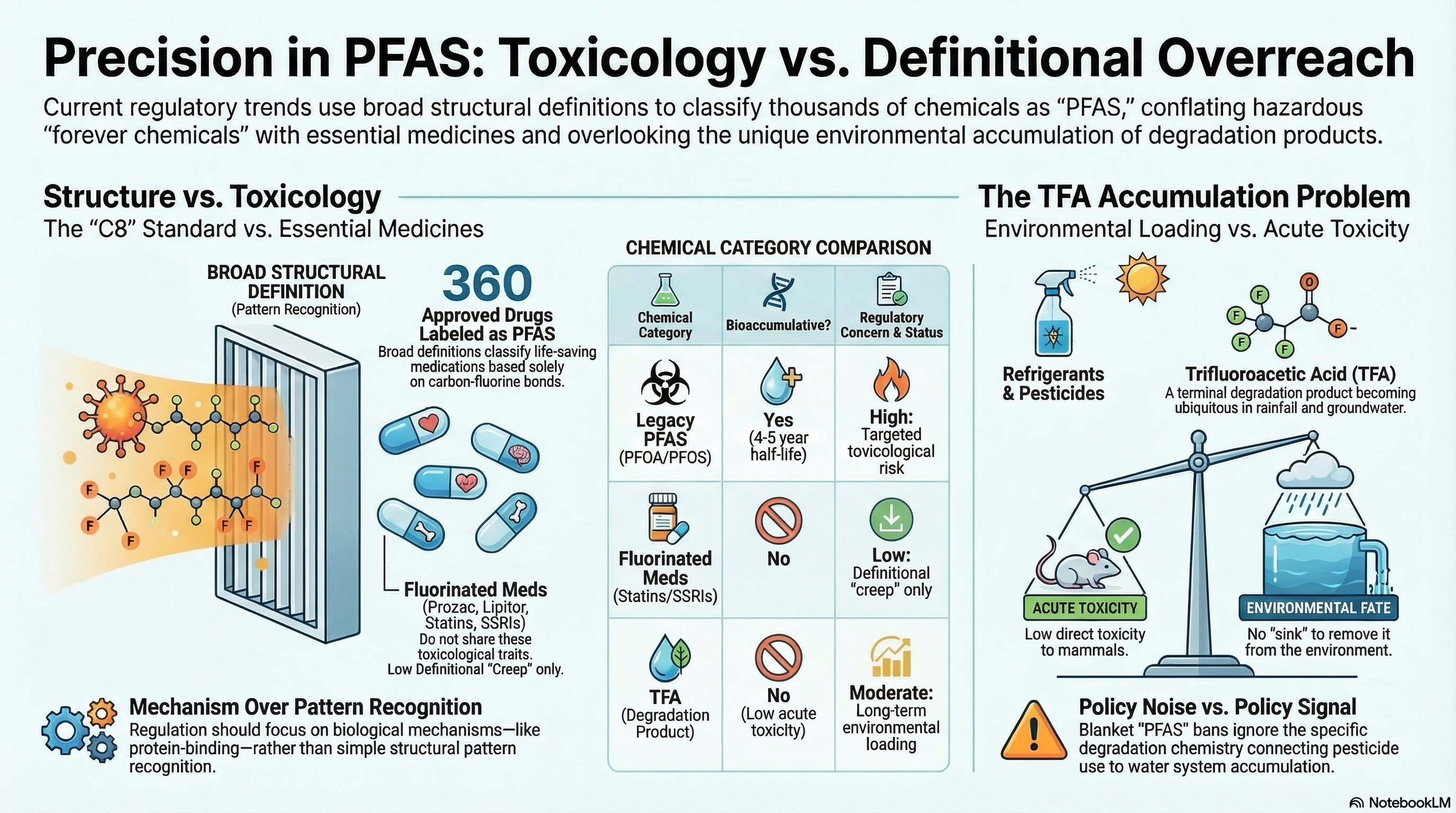
What the article does not do is distinguish between PFAS compounds with demonstrated toxicity at environmentally relevant doses and the vastly larger universe of organofluorine chemicals that share only a structural motif (e.g., the C-F bond). That distinction is of importance for toxicological sciences and discussion adding that I touched on this recently in a note.2
The Definitional Problem
The toxicological case for regulating long-chain perfluoroalkyl acids rests on data, but also specific mechanisms and adverse outcome pathways. Multi-year human serum half-lives (approximately 3.5–4 years for PFOA, approximately 5 years for PFOS),3 protein-binding-driven bioaccumulation, not lipophilic partitioning, where there are important mechanistic distinction. Here, PPARα-mediated hepatotoxicity in rodents, and immunotoxicity at environmentally achieved doses are characterized.4 These properties, documented across decades of epidemiological and mechanistic research, justify serious regulatory attention to perfluorooctanoic acid (PFOA, “C8”) and perfluorooctane sulfonate (PFOS).
The problem is not the science of C8. The problem is definitional scope creep and the tendency to lump or split categories without scientific justification.
An evaluation of 360 approved organofluorine pharmaceuticals against nine distinct PFAS regulatory definitions can mean most qualify as PFAS.5 Under the OECD 2021 definition, which requires at least one fully fluorinated saturated carbon (a –CF₃ or –CF₂– group), that figure is considerably lower, though still substantial. Captured under the broadest definitions include:
Fluoxetine (Prozac) — SSRI antidepressant
Atorvastatin (Lipitor) — statin, cardiovascular disease
Ciprofloxacin — fluoroquinolone antibiotic, WHO Essential Medicine
Fluconazole (Diflucan) — antifungal, WHO Essential Medicine
Fluticasone (Flonase) — inhaled corticosteroid
Efavirenz — antiretroviral for HIV, WHO Essential Medicine
Nirmatrelvir (Paxlovid) — SARS-CoV-2 protease inhibitor
Alpelisib — PI3K inhibitor, antineoplastic
Sitagliptin — DPP-4 inhibitor, antidiabetic
The classification of these drugs as PFAS under broad definitions reflects a category defined by the presence of a C–F bond, rather than any shared toxicological behavior. Fluoxetine, atorvastatin, and ciprofloxacin do not bioaccumulate, do not activate PPARα, and do not exhibit immunotoxicity at clinically or environmentally relevant doses. Grouping them with PFOA and PFOS is not scientifically descriptive, but deceptive, and a demonsatrate a regulatory classification that has come untethered from reality and mechanism. Much of the same needs to be applied to pesticides with a C-F bond.
Fluorine substitution is a foundational tool in medicinal chemistry and is increasingly used in pesticides to improve stability and target selectivity. At the same time, new definitional architectures are being applied to pesticide and industrial chemistry that sweep broadly enough to encompass a large share of approved organofluorine therapeutics. That is not an argument against regulating PFOA and PFOS. It is an argument for precision in how regulatory categories are defined, and for recognizing how definitions and terminology can be framed in ways that become half-truths in journalistic narratives.
The Chemistry Gets Complicated with Pesticides
The CNN/EWG framing is directed at agricultural pesticides. Here the subject becomes more complicated than the headlines suggest. Several fluorinated crop-protection compounds do warrant discussion, but doing so requires far more nuance and chemical specificity than most reporting allows. A number of widely used fungicides and insecticides such as Fludioxonil, Fluopyram, Fluxapyroxad, and Fipronil contain fluorinated motifs and have been detected in environmental monitoring studies, including municipal wastewater. In addition, older agrochemicals like Trifluralin and insect growth regulators such as Triflumuron illustrate how fluorine substitution has long been used in crop chemistry to influence stability, bioavailability, and biological activity.
A serious discussion would therefore examine specific compounds, their structures, persistence, degradation pathways, and exposure profiles. That level of precision is rarely compatible with headline narratives, but it is necessary if the goal is to understand real toxicological and environmental risks rather than collapse a wide range of unrelated fluorinated chemistries into a single category.6
The TFA Problem: Trifluoroacetic acid (TFA, CF₃COOH)
There is an important complication. This cuts in opposite directions from the definitional overreach and that involves what I previously implicated in life cycle analysis that can involve trifluoroacetic acid (TFA, CF₃COOH). TFA is the terminal degradation product of a large and growing fraction of fluorinated agrochemicals that include refrigerants, fluorinated solvents, and several of the pesticide active ingredients discussed above. This also for pharmaceuticals. TFA is becoming environmentally ubiquitous, detectable in rainfall, surface water, and groundwater across both hemispheres, and its atmospheric and terrestrial sinks are poorly characterized.
The regulatory status of TFA is contested and jurisdiction-dependent. The U.S. EPA has largely excluded TFA from TSCA PFAS reporting requirements, treating it as outside scope. The OECD 2021 definition includes it. The EU is actively litigating its treatment, and the flufenacet non-renewal and the Danish pesticide bans were both explicitly motivated by TFA groundwater accumulation. The GEUS TriFluPest study and ongoing European monitoring programs reflect genuine scientific concern about the long-term environmental loading trajectory.7
Some nuance required
But lets also be objective that TFA’s direct mammalian toxicity at current environmental concentrations is low and acute and subchronic studies in rodents show effects only at doses orders of magnitude above ambient exposure levels. But to preempt those inappropriately using acute toxicity as any sortof excuse8 - the concern is not acute toxicity. It is long-term environmental loading in a compound that is both highly water-soluble and highly resistant to abiotic and biotic degradation. This the life-cycle-analysis again, and the relevant regulatory questions should involve what chronic ecological exposure trajectory do we accept for a compound with no meaningful environmental sink. This is genuinely ignored and unresolved.
So, current discourse fails in both directions: it simultaneously overclassifies thousands of structurally diverse compounds as equivalently hazardous under a single “PFAS” banner, while underanalyzing the specific degradation chemistry that connects fluorinated pesticide use to long-term TFA accumulation in water systems. These are not the same problem and conflating them produces policy noise rather than policy signal.
On Sources and the Microphone Problem
Let me be direct (😠📢 😡📚 📊📄). We need objective science, and not headlines. Groups like the Environmental Working Group that include figures such as Ken Cook, Alexis Temkin, and Carey Gillam, and the Center for Biological Diversity represented by advocates like George Kimbrel and Nathan Donley are advocacy organizations with explicit policy objectives. Their framing reflects those goals, and while this is not a disqualifying observation or disparagement that advocacy organizations can play a legitimate role in public discourse, their outputs are routinely presented as non-objective fear-based unscientific assessments in news coverage.
The pattern is consistent: a small set of well-characterized, genuinely hazardous compounds where PFOA and PFOS foremost among them is used as the rhetorical anchor for claims about thousands of structurally unrelated chemicals. The category inflation is not accidental. It produces an emotional and political response that a more technically precise discussion would not. Toxicology is important, not substituting structural pattern recognition for mechanistic analysis and calling it science or scientific communication.
The discourse is systematic, journalists hand the microphone to the loudest advocacy voices rather than to those equipped to explain the underlying toxicology. The real analytical questions, which PFAS compounds bioaccumulate, at what doses, through what mechanisms, with what human and ecological endpoints, and what the regulatory implications of TFA’s unique environmental trajectory seen forever lost. Instead, we get “forever chemicals” as a narrative frame, applied indiscriminately, with the most alarming possible interpretation as the default.
That approach does not protect public health. It misallocates regulatory attention, erodes the credibility of legitimate chemical risk communication, and leaves the actual hard questions, TFA accumulation, dose-response characterization for emerging PFAS, the mechanistic basis for class-based regulation without the serious technical treatment they require.9
I would say “do better,” but journalistic integrity in this space seems less like something to restore and more like something that has already been spent, perhaps permanently. At this point, expecting genuine intellectual engagement feels closer to magical thinking than a realistic expectation in a media environment increasingly optimized for clicks and engagement.10
Stay safe out there
LaMotte S. “A surprising percentage of produce from the nation’s largest supplier contains ‘forever’ pesticides.” CNN Health, March 11, 2026. https://www.cnn.com/2026/03/11/health/pfas-pesticides-california-produce-wellness
Olsen GW, Burris JM, Ehresman DJ, Froehlich JW, Seacat AM, Butenhoff JL, Zobel LR. Half-life of serum elimination of perfluorooctanesulfonate,perfluorohexanesulfonate, and perfluorooctanoate in retired fluorochemical production workers. Environ Health Perspect. 2007 Sep;115(9):1298-305. doi: 10.1289/ehp.10009. PMID: 17805419; PMCID: PMC1964923.
EFSA Panel on Contaminants in the Food Chain (EFSA CONTAM Panel); Schrenk D, Bignami M, Bodin L, Chipman JK, Del Mazo J, Grasl-Kraupp B, Hogstrand C, Hoogenboom LR, Leblanc JC, Nebbia CS, Nielsen E, Ntzani E, Petersen A, Sand S, Vleminckx C, Wallace H, Barregård L, Ceccatelli S, Cravedi JP, Halldorsson TI, Haug LS, Johansson N, Knutsen HK, Rose M, Roudot AC, Van Loveren H, Vollmer G, Mackay K, Riolo F, Schwerdtle T. Risk to human health related to the presence of perfluoroalkyl substances in food. EFSA J. 2020 Sep 17;18(9):e06223. doi: 10.2903/j.efsa.2020.6223. PMID: 32994824; PMCID: PMC7507523.
Hammel E, Webster TF, Gurney R, Heiger-Bernays W. Implications of PFAS definitions using fluorinated pharmaceuticals. iScience. 2022 Mar 2;25(4):104020. doi: 10.1016/j.isci.2022.104020. PMID: 35313699; PMCID: PMC8933701.
I will add references here with time. Oxyfluorfen is a diphenyl ether herbicide with an aromatic C–F bond; classified as PFAS under broad definitions. Bifenthrin and lambda-cyhalothrin are synthetic pyrethroid insecticides; C–F substitution on the cyclopropane moiety. Fluopyram as a succinate dehydrogenase inhibitor (SDHI) fungicide; banned in Denmark in July 2025 as one of six active ingredients targeted over trifluoroacetic acid (TFA) degradation and groundwater contamination. Flufenacet as an acetamide herbicide; EU member states voted in March 2025 to support non-renewal of approval, formalized in Commission Implementing Regulation EU 2025/910 (May 2025), on grounds of endocrine disruption, where EFSA found TSH elevation, thyroid weight changes, and histopathological alterations—alongside TFA groundwater concerns.
Arp HPH, Gredelj A, Glüge J, Scheringer M, Cousins IT. The Global Threat from the Irreversible Accumulation of Trifluoroacetic Acid (TFA). Environ Sci Technol. 2024 Nov 12;58(45):19925-19935. doi: 10.1021/acs.est.4c06189. Epub 2024 Oct 30. PMID: 39475534; PMCID: PMC11562725.
We should value steelmanning over strawmanning.
Let me add a few additional thoughts I have not yet addressed. Essential medicines also enter wastewater as part of their life cycle. After administration, pharmaceuticals undergo Phase I and Phase II biotransformation in the body, and the resulting parent compounds and metabolites are excreted and ultimately reach wastewater systems. That pathway deserves consideration as well. (and as an aside, I was apparently “today years old” when I encountered references to Phase 0 and Phase III in pharmacokinetics—reminders that even the familiar ADME framework continues to evolve. )
There is an extensive literature on pharmaceutical residues in wastewater and aquatic systems, including work by the United States Geological Survey and other government and academic groups. The scientific and legal dimensions of these issues have not gone unnoticed either; past, present, and future litigation has engaged them in various ways. Which raises a more provocative question: if environmental persistence alone becomes the governing principle, do we then argue for banning the carbon–fluorine bond in essential pharmaceuticals? Many widely used drugs rely on fluorination for metabolic stability and therapeutic efficacy. The toxicological conversation becomes far more complicated when environmental detection, clinical necessity, and chemical functionality intersect.
In other words, once we widen the frame, the trade-offs become harder and more interesting to discuss. Just one reference that may be a start and of use:
Patel M, Kumar R, Kishor K, Mlsna T, Pittman CU Jr, Mohan D. Pharmaceuticals of Emerging Concern in Aquatic Systems: Chemistry, Occurrence, Effects, and Removal Methods. Chem Rev. 2019 Mar 27;119(6):3510-3673. doi: 10.1021/acs.chemrev.8b00299. Epub 2019 Mar 4. PMID: 30830758.
Really appreciate you taking the time to break down PFAS/C8 in a way that’s both readable and grounded in real-world implications! Your post makes it easy to understand why this isn’t just a technical issue, but a public health and accountability story.
One thing that could make the piece even stronger would be adding a bit more structure around “what readers can do next”. Even a short section that distinguishes individual actions (e.g., checking local water reports, filtration considerations) from civic/industry-level levers (regulatory updates, class actions, remediation funding) would help translate the urgency into clear pathways for engagement, especially for readers who are new to the topic.
Such a thoughtful, timely post!