
Why I'm Here
Understanding over certainty

The longer I have studied toxicology, the less interested I have become in certainty and the more interested I have become in understanding. I spent some time reflecting on my discourse and those reflections guided the creation of this graphic.
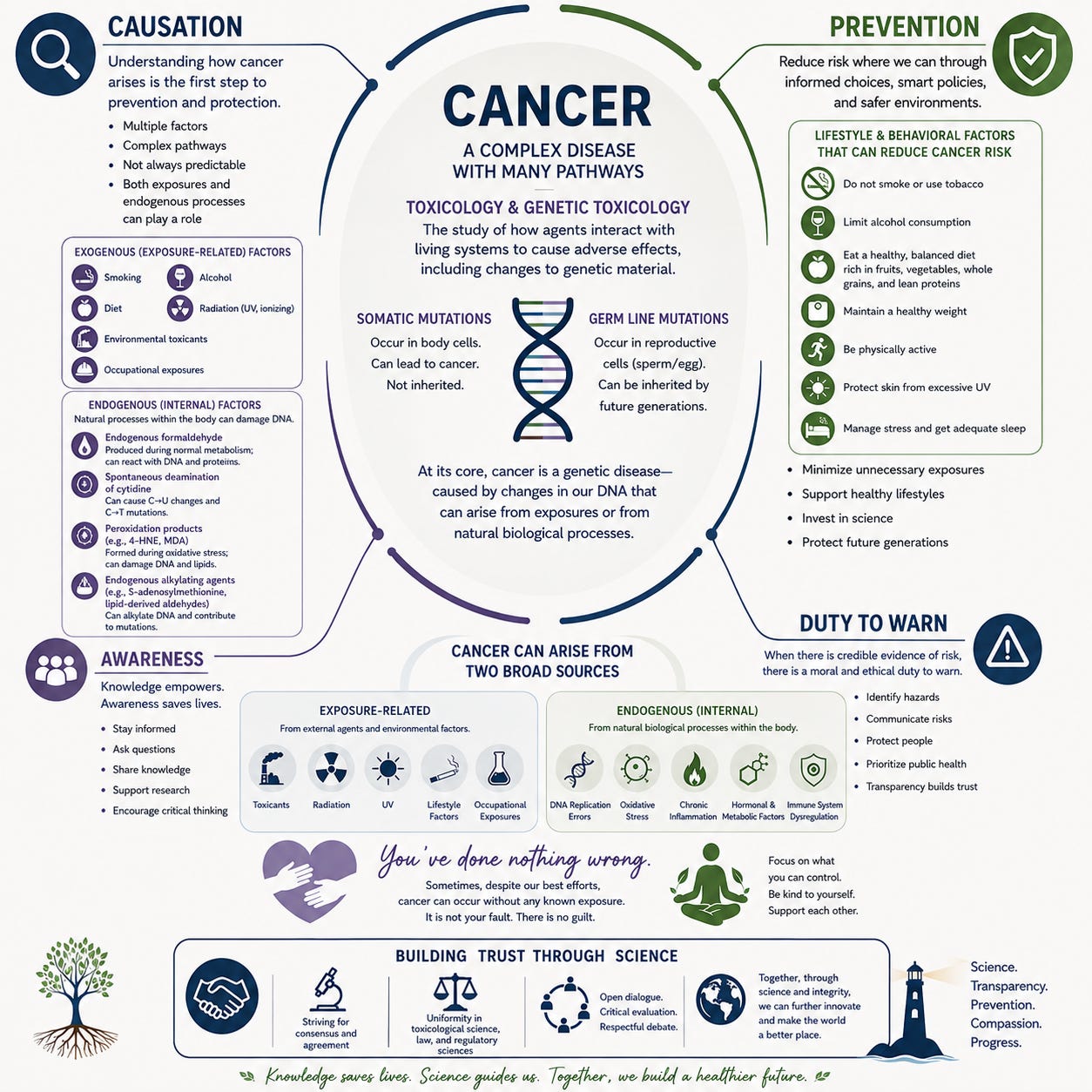
It started with the fundamental concepts of causation, prevention, awareness, and the duty to warn and if you have followed my writing, you know these themes are central to how I think about science and convergence at the intersection of toxicology, law, and regulatory science. A useful exercise - perhaps:
Understanding how cancer arises is the first step toward prevention and protection.
We can reduce risks through informed choices, thoughtful policies, and safer environments.
Awareness is empowering, and awareness can save lives.
When credible evidence exists, and when risk rises above acceptable limits, there is a moral and ethical duty to warn. This is a complex issue that crosses scientific, legal, societal, and economic interests.
There is so much more to explore regarding cancer theories, genetic toxicology, and the many steps required to better understand cancer risk. But the overarching message is clear. That knowledge saves lives. Science guides us and that together we can make the world a better place.
TL;DR - Humility
Cancer teaches humility. It reminds us that biology is extraordinarily complex, that certainty is often an illusion, and that simple stories rarely survive careful examination. But don’t stop storytelling is it’s important for scientific communication.
I am a proponent of somatic mutation theory as a foundational framework. Cancer is a genetic disease, and alterations can arise from preventable environmental exposures including chemicals, radiation, tobacco, alcohol, and infectious agents, but also from the intrinsic biochemistry of life itself. DNA replication errors occur despite the remarkable fidelity of polymerases where damaged DNA templates can yield mutations through oxidative stress, endogenous toxicants (e.g., formaldehyde), and spontaneous deamination of cytidine bases. I won’t again delve into theories, but mutations reflect countless molecular events with aspects of kinetics, repair, and evolution occur continuously throughout life in the body’s diverse array of cells of differing lineage and state of differentiation (e.g., potential, totipotency, and or competency).
Often in awe, with humility, vigilance, and compassion we have a responsibility to identify genuine hazards, reduce unnecessary exposures, and communicate risk honestly. Just as importantly, we must recognize that not every disease has an identifiable external cause and no one deserves to carry guilt for a diagnosis that can emerge from an inherent vulnerability of biology itself. The serenity prayer might apply:
“God, grant me the serenity to accept the things I cannot change, the courage to change the things I can, and the wisdom to know the difference.”
As I’m often drawn to topics at the intersection of toxicology, law, and regulatory science, I increasing realize that answers are not found in dogma, ideology, outrage, or absolute certainty. Anger and emotion can be understandable, leveraged in some instance, but far too often unproductive and erodes trust. Science advances through systematic observation, transparency, replication and reproducibility, constructive criticism by enemies (that will work for free) and a willingness to revise our views when better evidence emerges.
I’ve thought often about how AI can be both beneficial and harmful. Try not to forget that science is more than a collection of facts assembled into a simulated intelligence. Scientific strength is not built on hallucinations or unanimous opinions, but on methods that allow independent investigators to reach increasingly reliable conclusions and that “extraordinary claims require extraordinary evidence”. Consensus, when honestly earned, is not conformity but one way science achieves greatness. I worry that we have become too comfortable embracing divisive rhetoric and conflict, losing sight of the common purpose that unites scientists, physicians, regulators, and the public: reducing suffering, improving health, and leaving the world better than we found it.
I’ll strive to do better. Today, I thought I’d imply reflect on how my own small contributions might best serve some purpose. Perhaps this can be a space to examine evidence carefully, question assumptions respectfully, and explore how toxicology, law, and regulatory science with layers and focusing on genetic toxicology and cancer research can inform wiser decisions and duties
Knowledge ➡️ shared with integrity ➡️ builds trust ➡️ enables cooperation ➡️ makes innovation possible. That cumulative process where science seeks to explain the world and help us make it better for everyone.
Stay safe out there,
This is a beautiful reflection, Brian. You frame humility as a scientific strength, a deeper commitment to understanding (versus a retreat from rigor). I like your emphasis on method, responsibility, and honest communication, capturing the part of science that actually builds trust. I'm enjoying your ideas.