
Some Toxicology Notes
Here are a couple of long notes that I hope to develop into much stronger articles

If you’ve noticed, many of my notes run long and sometimes exceed what most people would consider a typical article. What you are reading is already the condensed version. These pieces are distilled from much larger drafts and research notes that I gradually refine into something more readable. (🤔😂). Below are three topics I am currently developing, with links to the original notes they grew out of. I usually include references throughout, but looking back I can see that several sections still need additional sourcing and citations. Here’s what’s coming:
Symbols, Labels, Law, and Regulation
Legal Correspondence, Immunity, and Monsanto v Durnell
Molecular Reality Over Origin Myths Beyond Chemophobia
In Symbols, Labels Law, and Regulation
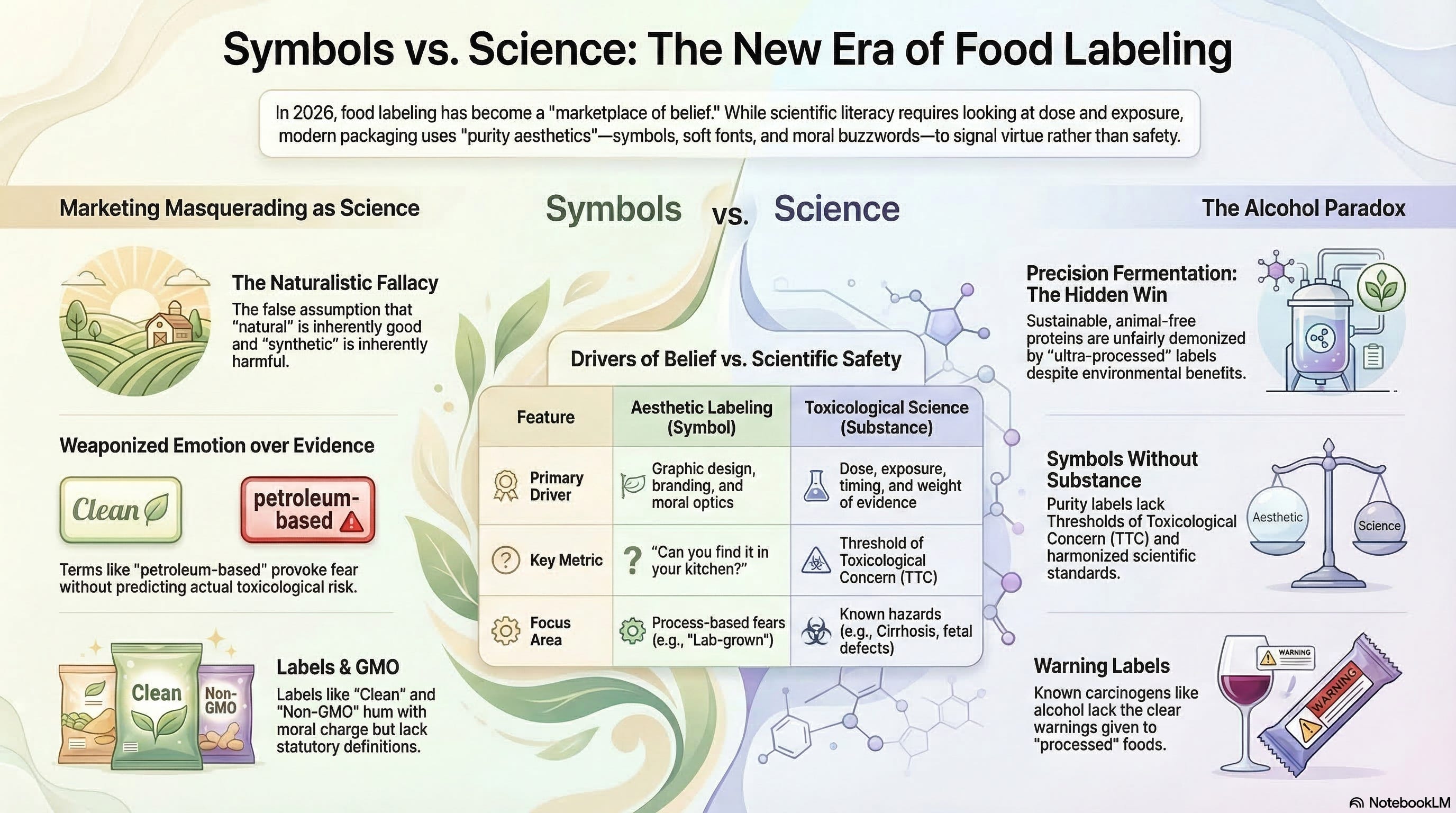
I started from the perspective of how food labeling has increasingly drifted away from toxicological science toward performative marketing. Terms like “clean,” “natural,” and “pesticide-free” carry moral meaning but lack defined exposure thresholds, mechanistic basis, or consistent risk metrics.
I expect to see more pseudo-certifications such as “NON-UPF” amplify this trend as operating with vague subjective standards while shaping consumer perception. I’d also expect more regulatory asymmetries where “natural” ingredients often face lighter scrutiny rather than closing the loopholes. The labeling landscape will be driven less by exposure, dose-response, and weight-of-evidence toxicology than by marketing, identity, and purity narratives.
Legal Correspondence, Immunity, and Monsanto v Durnell
I think I shocked a few I correspond with pointing out that significant constitutional arguments are missing in Monsanto v. Durnell. I started pointing out that immunity claims are a red herring; design defect, duty to warn, and negligence remain fully litigable regardless of what you read on social and mainstream media, or from politicians. Lawmakers should better at understand the law.
It wasn’t hard to demonstrate numerous constitutional angles that appear largely absent after reading and analyzing many of the SCOTUS briefs. I was pretty disappointed. I’ve added perspectives involving the State of California where unconstitutional delegation that effectively triggers warning obligations when a substance is classified by International Agency for Research on Cancer without independent state scientific review, rulemaking, or a meaningful challenge mechanism; this framed as outsourcing of State police power to an external body. There are also Dormant Commerce Clause concerns, since a single state warning requirement that conflicts with the conclusions of regulators such as the United States Environmental Protection Agency can effectively shape national and international commerce. A related Foreign Commerce Clause argument arises because tethering state law to a body within the World Health Organization may disrupt federal uniformity in foreign commerce and complicate U.S. trade commitments. The note also points to potential due process issues, given the lack of notice, hearing, or state-level review before the warning obligation attaches, and to First Amendment compelled speech concerns, particularly where a mandated warning may directly contradict the EPA’s scientific determination. Even if each argument might be debatable in isolation, the author suggests that the cumulative constitutional weight could be significant. With billions of dollars in liability at stake, the continued silence around these angles is difficult to explain.
In “Molecular Reality Over Origin Myths Beyond Chemophobia”
I must say I was a bit ashamed at first draft notes. This remains is a work in progress. It lacked very important dimensions and with reflection I’ve realized my framing has several blind spots. Alongside my usual arguments that toxicology demands more depth than “the dose makes the poison,” I’ve overlooked additional natural-versus-synthetic discussions and and will substantially expand this piece to address sets of materials I omitted entirely: asbestos, crystalline silica, combustion-derived particulates (PM₂.₅), synthetic polymers, and microplastics.
I should probably address the term chemophobia better, it misuse, and note that it ought to be used with great care. Fear is a powerful motivator, but understanding has the potential to replace fear giving people clear explanations as to how chemicals actually interact with biological systems. I will try to add examples and special cases that challenge conventional dose–temporal–response thinking and illustrate where toxicology becomes more nuanced than simple linear assumptions.
Toxicity can be shaped (pun intended) not only by chemical composition but by physical form. particle, polymer, fiber geometry, size and surface area, biopersistence, and even aerodynamic behavior matter. Risk frameworks that ignore these additional aspects are incomplete. Reading back on my first drafts, I see the typos I can’t seem to stop and hope, when corrected, this piece that has grown into more than six parts being a more formal work. Clearly it may need significant condensation here.
Does dose make the poison? Short answer: yes. Longer answer: oh boy, buckle up. I’ll likely drone on this again, but surely the law of mass action and chemical master equations remain and hold true. But even my niche, devastatingly good looking intelligent audience might agree that when theory hits practice, topics becomes byzantine in structure, arcane in detail, and a labyrinthine in practice.
Close
So to close, here is what the next generation summary looks like:
This piece that argues that the natural/synthetic dichotomy is scientifically incoherent as a basis for chemical risk assessment as naturalistic fallacies that cut both ways. Given my age, I will yet again point back to established facts that nature can produce potent carcinogens and mutagens. Ames and Coon demonstrated that these natural exposures can dwarf those synthetic residues by roughly four orders of magnitude. However, the corrective is not to dismiss synthetic chemistry: structurally novel compounds like PFAS and PCBs can be metabolically and environmentally persistent in ways natural phytotoxicants rarely are, because biological degradation machinery co-evolved with natural substrates, not halogenated structures with no evolutionary precedent.
Will the dose make the poison? Yes, but chemistry and frameworks must also extend into particulate toxicology where asbestos, crystalline silica, PM₂.₅, polymers, and microplastics add complexities of physical form, fiber geometry, surface reactivity, and biopersistence. Here again, rather than subjective terms regarding molecular identity or origin, chemistry will govern biological activity.
Integrating lifecycle analysis adds a much needed temporal dimension: natural toxins typically close their environmental cycle quickly, while persistent synthetics accumulate globally through biomagnification across trophic levels. The proposed unified framework therefore evaluates chemical risk across four dimensions where intrinsic hazard, exposure, persistence, and physical form with origins serving at best as a weak heuristic and at worst as a distraction from the structural, mechanistic, and quantitative questions that actually determine risk.
I know this covers a lot of mixed topics that will hopefully be more digestible once they’re split into separate articles. I wrote this quickly this morning, so a bit more refinement is still ahead.
Stay safe out there.