Monograph Program Key Limitations
Glyphosate Litigation

Glyphosate
Is eleven billion dollars a lot of money? Litigation truly starts with the monograph program findings in 2015. And it's pretty important to understand the ‘key limitations’ that distinguish it from global regulatory agencies. The monograph program:
(1) Does not assess all data.1
(2) Lacks competency in performing quantitative risk characterizations.2
(3) Now relies on subjective, non-quantitative ‘characteristics’ that can be unreliable for hazard determinations.3
(4) Lacks the transparency and rigor of regulatory assessments.4 And importantly,
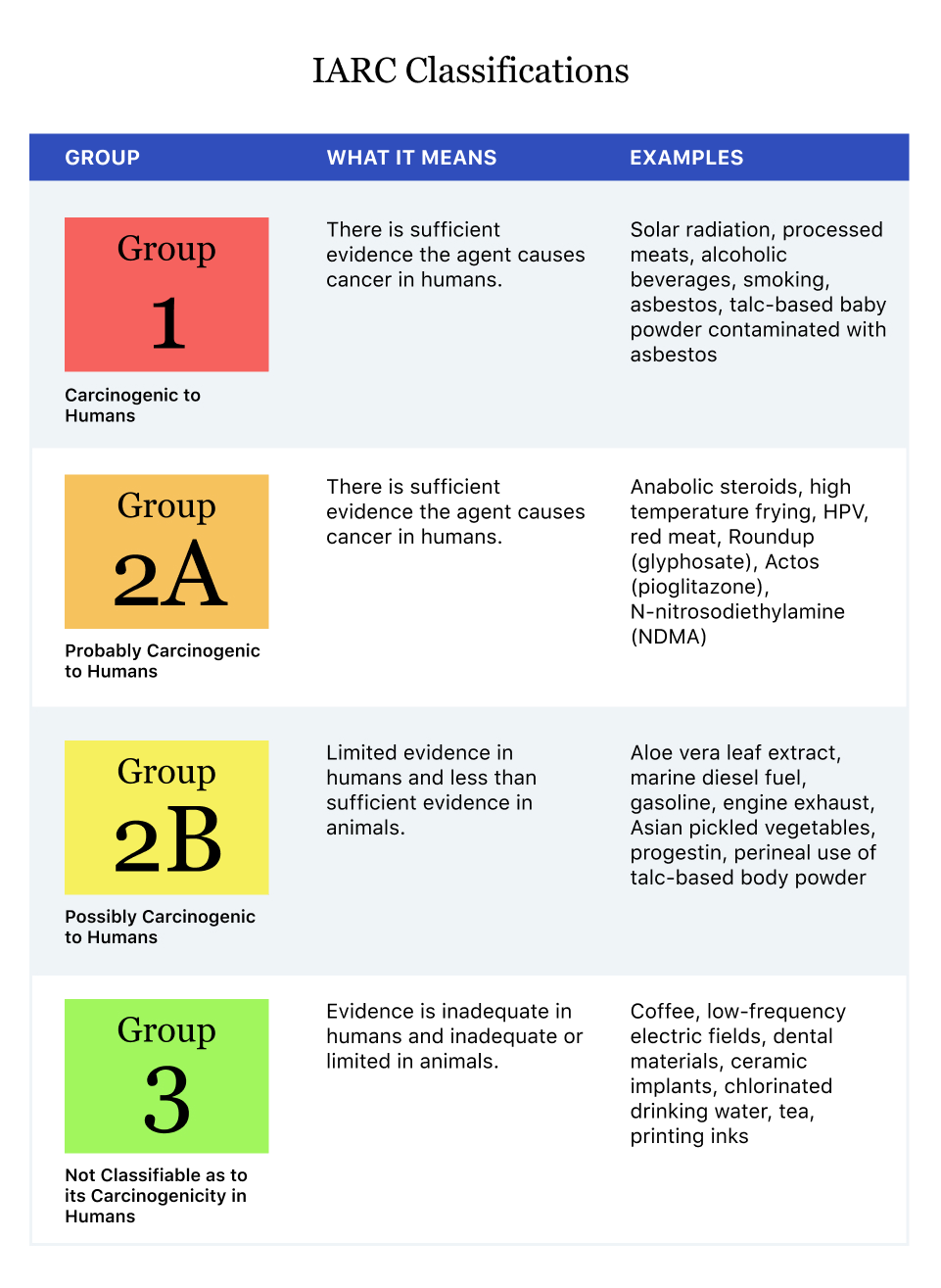
(5) The monograph program selects and categorizes chemicals in only one direction. Consider that Group 4: "Probably NOT carcinogenic to humans" no longer exists.
So, contrary to its intended mission related to cancer prevention5, the monograph program falls short of the capabilities of regulatory bodies proficient in risk assessment, and in that shortfall, poses a THREAT to your ability to have accurate and trustworthy information to judge the benefits and risks of chemicals, technologies, and occupations.
Details below...
IARC Monographs Preamble – Preamble to the IARC Monographs (amended January 2019) (LINK) [page 8] Section 6. Overview of the scientific review and evaluation process “only studies that have been published or accepted for publication in the openly available scientific literature are reviewed.”
Report of the IARC Advisory Group To Recommend On Quantitative Risk Characterization, INTERNAL REPORT 14/001, 18–19 November 2013 Chaired by Christopher Portier (LINK) [page 6] Regarding Quantitative Risk Characterization (QRC) “If IARC wishes to pursue QRC to the point of developing risk estimates, combining these risks with exposures and predicting cancer burden, additional resources will need to be committed by the Agency to accomplish this goal. Establishing partnerships with other groups with expertise in QRC would also help in achieving this goal.”
Becker RA, Dreier DA, Manibusan MK, Cox LAT, Simon TW, Bus JS. How well can carcinogenicity be predicted by high throughput "characteristics of carcinogens" mechanistic data? Regul Toxicol Pharmacol. 2017 Nov;90:185-196. doi: 10.1016/j.yrtph.2017.08.021. Epub 2017 Sep 1. PMID: 28866267. (LINK) [Open Access] “Using the same assignments as IARC of ToxCast/Tox21 assays to the seven key characteristics of carcinogens, the ability to predict cancer hazard for each key characteristic, alone or in combination, was found to be no better than chance.”