
A Note from bigFood
In Praise of Science and Engineering

Just a quick note to praise science and engineering in the modern day. Despite centuries of so-called “culinary arts,” it took actual tobacco engineers and scientists to finally achieve cookie perfection through the careful, almost reverent processing of flour, sugar, fat, and eggs.
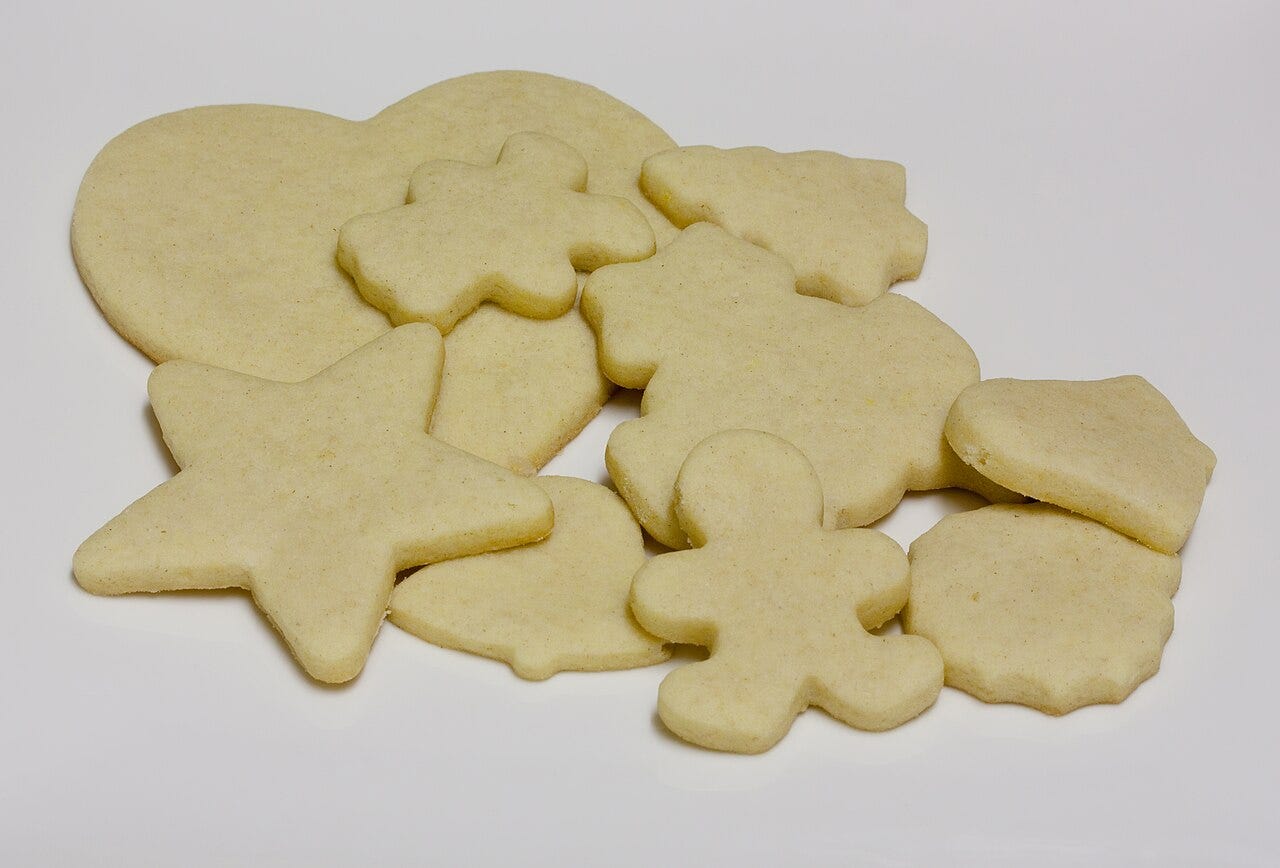
It seems undeniable now, with litigation impending, that achieving a reproducible “bliss point” may turn out to be a miscalculation that can cost us dearly. We here at bigFood have spent decades perfecting the science of turning raw materials into palatable food, and discovery may show we sought to gain market share, and that we knew it is simply impossible to replicate our cookies in your own kitchen through non-industrial means.
It is a matter of fact that your oven is not a facility. Your mixing bowl is not a unit operation. Achieving bliss points require capital expenditures and years of corporate oversight. We say this with love: your home kitchen produces, at best, substandard tasty treats, on account of your lacking the training, equipment, and experience of our scientists.
Under our new “Real Cookie” branding from our “Real Food” division, developed in close conceptual alignment with current HHS leadership, we will never substitute butter with alternative fats, margarine, or anything containing ingredients that sound like they might require phonetic guidance (e.g., sodium benzoate). Our legal department and accountants have independently advised that if senior officials cannot confidently pronounce an ingredient that it presents a nontrivial regulatory risk.
In addition, we will strategically embrace the natural consequences of using only “real” ingredients, including the accelerated development of bacterial and mold ecosystems. While this may shorten shelf life and increase food waste, we are exploring whether increased purchase frequency may offset these losses in a manner consistent with shareholder expectations. Additionally, the prevailing scientific narratives suggest that the moment one substitutes butter with anything remotely shelf-stable, one crosses irreversibly into the realm of “hyper-processed.” We do not define these terms; we merely comply with them, interpret them, and occasionally reorganize entire product lines around them. As always, we remain committed to following the science, the law, and whichever interpretation of both is currently trending.
With the above, our legal department warns that should you attempt to reverse-engineer our proprietary processes and somehow achieve a bliss point in your own kitchen, you are hereby deemed a manufacturer and assume all attendant liabilities. Any resulting claims of addiction, emotional dependence, unexplained happiness, holiday overconsumption, or neighborhood envy should be directed to our legal department. Nothing in this memo constitutes an admission that a bliss point exists, that bliss can be measured, that bliss can be engineered, that cookies are capable of producing bliss, or that our scientists occasionally high-five one another after sensory panel results come back. Furthermore, references to “cookie perfection” should be understood as aspirational marketing language and not as a statement of scientific fact, despite the accompanying 400-page validation dossier.
Finally, discovery may reveal that we knew and prepared internal models estimating the long-term consequences of sustained exposure to reproducibly engineered cookies. These models examined outcomes including weight gain, metabolic dysfunction, elevated cholesterol, reduced trouser integrity, and statistically significant increases in the frequency with which consumers utter the phrase, “I’ll just have one more.” We stress that these analyses were purely hypothetical, purely academic, and purely unrelated to any documents currently under subpoena. Any resemblance between our forecasting models and real-world outcomes is coincidental, unforeseeable, and, according to counsel, protected by attorney-client privilege. Most importantly, nothing contained herein should be interpreted as evidence that we knew what we were doing, even if internal emails occasionally used phrases such as “mission accomplished” achieved “maximum cookie market penetration.”
In closing, our marketing division would like to clarify that any resemblance between our products and “food” is entirely intentional, extensively tested, and focus-group validated across multiple demographics, including “people who like cookies” and “people who previously liked cookies but now like these more.” Our campaigns are guided by a rigorous commitment to emotional resonance and nostalgia amplification. We do not target children; we simply ensure that our packaging, color palettes, mascot design, shelf placement, and digital engagement ecosystems are coincidentally irresistible to them.
We further note that any historical collaboration, inspiration, or parallel evolution involving beloved educational programming is purely hypothetical examples might include blue, cookie-enthusiastic figures associated with public broadcasting should not be construed as evidence of coordinated messaging strategies. Any overlap between our brand identity and characters who espouse the singular joy of cookie consumption reflects, at most, a shared commitment to evidence-based enthusiasm. To the extent that such figures have appeared in proximity to our products, messaging, or cultural footprint, this should be understood as organic alignment rather than the result of targeted outreach, licensing frameworks, or decades-long brand affinity cultivation.